
Metabolic syndrome · Care programme

One programme for metabolic syndrome. Managed from stage 1.

For health insurers, practice networks and programme partners: myon.clinic turns the staging model of the 2025 EAS consensus into a digital care programme. Every new value is checked, the stage is updated, the right specialty is brought in and the work is documented in a structured way.

Illustrative example over ten years across three levels: the patient provides values from the app, home devices and lab. myon.clinic checks each value against the thresholds of the EAS consensus, recalculates the stage, assigns the matching pathway and routes to the right specialty. Stage 0, year 0: baseline with home devices, standard pathway, GP practice. Stage 1, year 3: waist-to-height ratio 0.56 and Fatty Liver Index 64, lifestyle, sleep and liver modules, routed to GP practice, obesity medicine and nutrition counselling. Stage 2, year 6: HbA1c 51 and UACR 12, kidney, liver and vessel modules, routed to endocrinology, nephrology, hepatology and preventive cardiology. Stage 3, year 10: eGFR 38 and heart failure, shared record, routed to heart failure cardiology, nephrology and dialysis, hepatology and palliative care.
  1. Stage 0Year 0
    Baseline with home devices
    Stage 0Standard pathway
    • GP practice
  2. Stage 1Year 3
    Waist-to-height 0.56 · FLI 64
    Stage 1 detectedLifestyle · Sleep · Liver
    • GP practice
    • Obesity medicine
    • Nutrition counselling
  3. Stage 2Year 6
    HbA1c 51 · UACR 12
    Stage 2 detectedKidney · Liver · Vessels
    • Endocrinology
    • Nephrology
    • Hepatology
    • Preventive cardiology
  4. Stage 3Year 10
    eGFR 38 · HFpEF
    Stage 3 detectedShared record
    • Heart failure cardiology
    • Nephrology & dialysis
    • Hepatology
    • Palliative care
Illustrative example over ten years across three levels: the patient provides values from the app, home devices and lab. myon.clinic checks each value against the thresholds of the EAS consensus, recalculates the stage, assigns the matching pathway and routes to the right specialty. Stage 0, year 0: baseline with home devices, standard pathway, GP practice. Stage 1, year 3: waist-to-height ratio 0.56 and Fatty Liver Index 64, lifestyle, sleep and liver modules, routed to GP practice, obesity medicine and nutrition counselling. Stage 2, year 6: HbA1c 51 and UACR 12, kidney, liver and vessel modules, routed to endocrinology, nephrology, hepatology and preventive cardiology. Stage 3, year 10: eGFR 38 and heart failure, shared record, routed to heart failure cardiology, nephrology and dialysis, hepatology and palliative care.
  1. Stage 0Year 0
    Baseline with home devices
    Stage 0Standard pathway
    • GP practice
  2. Stage 1Year 3
    Waist-to-height 0.56 · FLI 64
    Stage 1 detectedLifestyle · Sleep · Liver
    • GP practice
    • Obesity medicine
    • Nutrition counselling
  3. Stage 2Year 6
    HbA1c 51 · UACR 12
    Stage 2 detectedKidney · Liver · Vessels
    • Endocrinology
    • Nephrology
    • Hepatology
    • Preventive cardiology
  4. Stage 3Year 10
    eGFR 38 · HFpEF
    Stage 3 detectedShared record
    • Heart failure cardiology
    • Nephrology & dialysis
    • Hepatology
    • Palliative care
The situation

Most people in midlife already have a stage.

In a large European cohort, around three quarters of 40- to 69-year-olds already meet the criteria for stage 1 or 2. The high costs come later, with heart failure, kidney failure and cardiovascular events. In between lies the window in which care can still be managed. Today, it is spread across separate practices.

Where Europe’s midlife population stands

European UK Biobank participants aged 40 to 69, by EAS stage
Organ damage and risk increase
Where stage 3 leads3.1M

cardiovascular deaths per year in ESC member countries2

The share in stage 3 was not calculated in the analysis. Sources: Romeo et al., EHJ 20251; Timmis et al., EHJ 20242.

59%

of adults in the WHO European Region live with overweight or obesity.

WHO Europe 20224
€282bn

was the cost of cardiovascular disease to the EU economy in 2021, including €155 bn in health and long-term care.

Luengo-Fernandez et al. 20233
€630

cost of cardiovascular disease per EU citizen per year.

Luengo-Fernandez et al. 20233
Who it’s for

For everyone who runs care as a programme.

Practices and specialists work with myon.clinic. A programme is sponsored by those who organise or fund care for many people.

Care management at a health insurerHealth insurers

Manage earlier, before it gets expensive.

  • Support insured members in a structured way by EAS stage
  • Bring in specialties precisely when a threshold is reached
  • Structured documentation that can be analysed for reports
Discussion within a practice networkPractice networks & care alliances

One pathway for every practice in the network.

  • Shared pathway for GP and specialist practices
  • Handover with full stage history
  • Multi-tenant for multiple sites and regions
Doctor in a practiceProgramme partners

Programmes that reach everyday practice.

  • Certified medical device as infrastructure
  • Blueprint: National Lipid Campaign
  • Treatment decisions stay with physicians
The model

Three stages. Each with a measurable threshold.

In 2025, the European Atherosclerosis Society described metabolic syndrome as a systemic metabolic disorder with three stages1. Because each stage is defined by specific lab values and findings, it can be checked automatically.

Stage 1Before organ damage

Metabolic abnormalities

Insulin resistance or prediabetes alone, or excess body fat plus one other feature.

Thresholds
  • HOMA-IR ≥ 2.5
  • HbA1c 39–47 mmol/mol
  • BMI ≥ 25
  • Waist-to-height ≥ 0.5
  • FLI ≥ 60
  • BP ≥ 140/90
  • apoB ≥ 1.8 µmol/L
Stage 2Early organ damage

The organs show it

Type 2 diabetes, MASH or liver fibrosis, albuminuria or subclinical atherosclerosis.

Thresholds
  • HbA1c ≥ 48 mmol/mol
  • FNI > 0.33
  • Fibrosis F2–F3
  • UACR 3–29 mg/mmol
  • CAC > 100
  • Diastolic dysfunction
Stage 3Advanced organ damage

Multiple organs affected

Heart failure, cirrhosis, kidney failure or a clinical cardiovascular event.

Findings
  • HFpEF
  • Fibrosis F4
  • eGFR < 60
  • Myocardial infarction
  • Stroke
  • PAD

The foundation at every stage: lifestyle change first, then stage-appropriate medication and, where indicated, metabolic surgery.

Patient journey

Supported by stage. Handed over to the right specialty.

An example over ten years: with each stage, what myon.clinic handles for the patient and the care team changes, and so does who leads care.

    • GP practice
    Stage 0

    Metabolically healthy

    Year 0. All values in the target range. The GP practice enrols the patient.

    myon.clinichandles
    • Standard pathway for metabolic syndrome
    • Welcome Caretasks
    • Lifestyle education
    • Baseline with home devices
    • Reminders for annual check-ups
    • GP practice
    • Obesity medi­cine
    • Nutrition coun­selling
    Stage 1

    Metabolic abnormalities

    Year 3. Waist-to-height 0.56, HbA1c 42 mmol/mol, FLI 64. No organ damage yet.

    myon.clinichandles
    • Caretasks on body measurements
    • Structured lifestyle programme
    • Sleep apnoea screening
    • FIB-4 liver check
    • Lipid monitoring with apoB
    • Endo­crinology
    • Nephro­logy
    • Hepato­logy
    • Preventive cardio­logy
    Stage 2

    Early organ damage

    Year 6. HbA1c 51 mmol/mol, UACR 12 mg/mmol, CAC score 180. No symptoms yet.

    myon.clinichandles
    • SCORE2 risk assessment
    • Automatic KDIGO classification
    • Atherosclerosis work-up
    • Referral for elastography
    • Medication check-in after 2–4 weeks
    • Heart failure cardio­logy
    • Nephro­logy & dialysis
    • Hepato­logy
    • Palliative care
    Stage 3

    Advanced organ damage

    Year 10. Heart failure (HFpEF), eGFR 38. Three teams, one shared plan.

    myon.clinichandles
    • Daily weight and symptom tracking
    • NT-proBNP trend
    • Renal dosing alerts
    • Shared record for heart, kidney and liver
    • Coordination of palliative care
Automatic re-staging
  1. Patient completes a Caretask
  2. Threshold check per EAS
  3. Stage is recalculated
  4. Pathway is assigned
  5. Care team is notified

With a stability check and protection against premature downgrading.

Illustrative patient journey. Values, intervals and specialties involved are an example and do not replace a physician’s assessment.

How myon.clinic works

The consensus describes the stages. myon.clinic puts them into practice.

The platform takes over what used to be coordination by phone, fax and reminders: checking values, deriving the stage, assigning tasks and documenting everything.

Automate staging

Every incoming value is checked against the thresholds, and the stage is recalculated as soon as it arrives.

Coordinate the team

The right task reaches the patient, and the right referral reaches the right specialty, with the full stage history.

Document the work

Monitoring, device data and physician time are recorded in a structured way and can be analysed.

1 · Values arrive
  • Patient app & Caretasks
  • Wearables & home devices
  • Lab & imaging
2 · The stage is determined

Staging and orchestration layer

Thresholds, warning signs and escalation rules per pathway, maintained in one place.

  • EAS 2025
  • SCORE2
  • KDIGO
  • EASL-EASD-EASO
3 · The team acts
  • GP practice
  • Cardiology
  • Nephrology
  • Endocrinology & diabetology
  • Hepatology

The platform prepares and routes. Every clinical decision stays with the treating physician.

Pathway library

One standard pathway. Four modules that switch on automatically.

All patients start on the same core pathway. As soon as a value crosses a threshold, the matching module is added.

Standard pathway · for everyone

Metabolic syndrome

The core pathway collects the values needed for staging and schedules the check-ups.

  • Onboarding and body measurements
  • Metabolic and kidney values
  • Lipid profile with apoB
  • Home device pairing
  • Check-up schedule
Vessels

Subclinical atherosclerosis

Triggered byHigh-risk SCORE2 or apoB above target

Adds calcium scoring and carotid imaging.

Liver

MASLD and fibrosis

Triggered byFatty Liver Index ≥ 60 or type 2 diabetes

Collects the values for FIB-4 and refers for elastography.

Kidney

Kidney risk

Triggered byUACR 3–29 mg/mmol or declining eGFR

Classifies per KDIGO and sets the monitoring interval.

Sleep

Sleep apnoea

Triggered byObesity plus one other feature

Validated questionnaire, with referral if positive.

Thresholds per Romeo et al., EHJ 20251 · Risk classification per SCORE2 (ESC)5 · Kidney categories per KDIGO6 · Liver pathway per EASL, EASD and EASO 20247
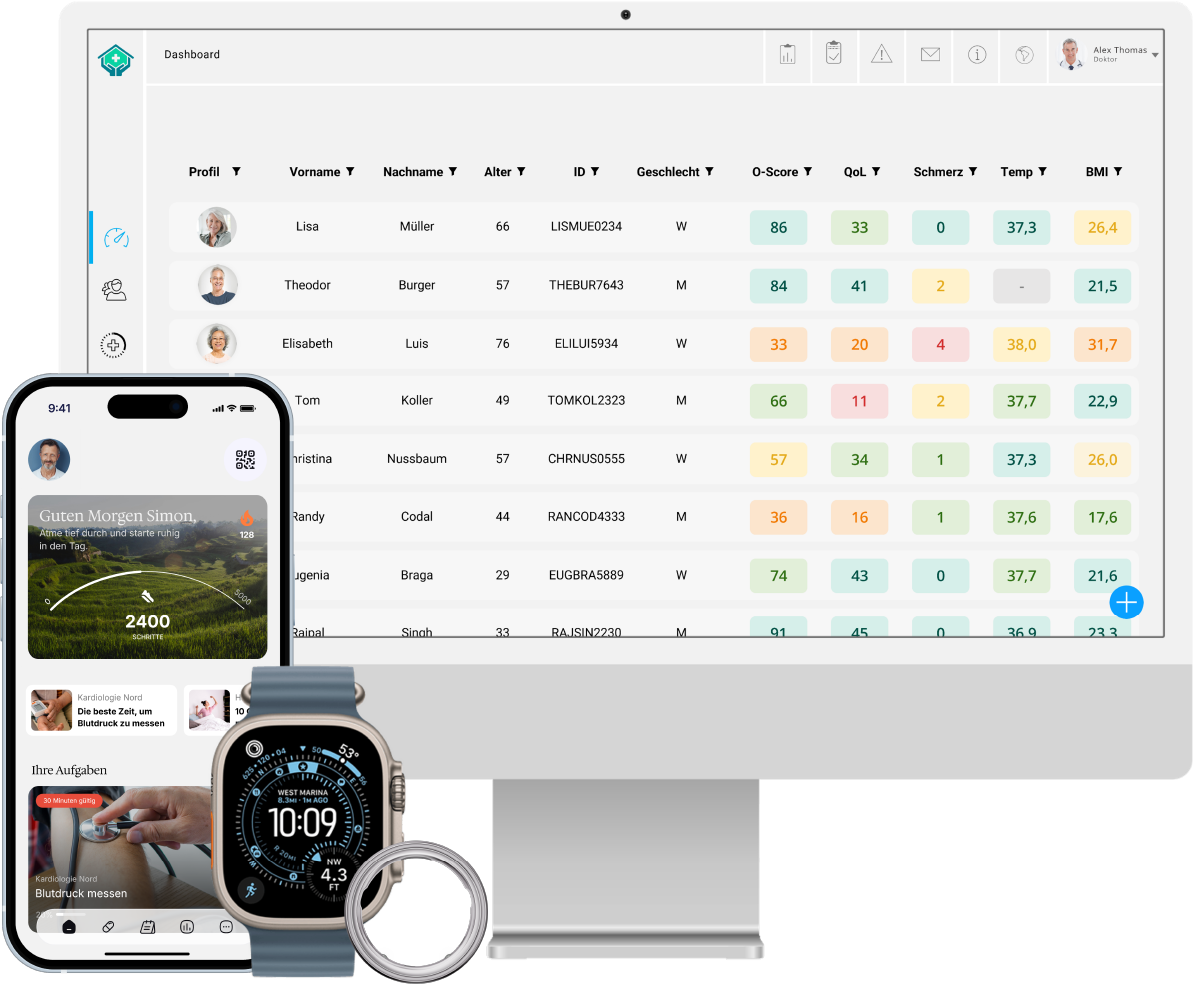
The myoncare app on a smartphone and the care team platform in a browser
For the care team

The cockpit care coordination never had.

The team sees at a glance who is at which stage and who has just crossed a threshold. Patients use the myoncare app or a browser.

  • Patient panel by stageComplete overview, sortable by stage.
  • Escalation queueShows who has crossed a threshold.
  • Referral with historyHandover with full stage history.
  • Appointments, chat and videoBooking, secure messaging and video consultations in one place.
  • Devices and wearablesApple Health, Google Health, Withings, plus FHIR and HL7 interfaces.
  • Education in the patient’s own languageMultilingual patient content, with structured, analysable documentation.
Implementation routes

Three routes to your own programme.

The EAS model is a scientific consensus, not an obligation for practices. To reach routine care, it needs a programme sponsor. These routes are possible:

Health insurers

Special care contract

FrameworkSection 140a SGB V10

A health insurer and care providers agree a programme for a defined group of insured members. myon.clinic provides the pathways, platform and documentation.

Insurers & networks

Link to DMP structures

FrameworkDMPs for type 2 diabetes, CHD, obesity

Many practices already document in disease management programmes (DMPs). The DMP for adults with obesity has been in the directive since July 2024 but is not yet offered8. By July 2027, the Federal Joint Committee (G-BA) is having the evidence base updated, explicitly including digital applications9.

Programme partners

Partner programme

ModelNational Lipid Campaign

Partners fund a programme, and practices support their patients via the certified platform. Every treatment decision stays with the physician.

Not legal advice. We’ll work out together which route suits your organisation.

Blueprint for programme partners

What a partner programme looks like in practice.

Lipids are one criterion of metabolic syndrome. The National Lipid Campaign shows how partners, operators and practices work together. A metabolic syndrome programme uses the same players and the same platform, with different thresholds.

National Lipid Campaign: patient support in a practice
National Lipid Campaign · Germany

“Lipid management doesn’t end at the check-up.”

Together with BNK Service and Novartis, myon.coach, a joint venture of myon.clinic and BNK, launched the National Lipid Campaign. Practices support lipid patients between appointments with the MDR class IIa certified myoncare platform.


  • LDL-C targets per SCORE2
  • Wearable and lab tracking
  • Reminders
  • Risk-based triage dashboard
Partners
  • myon.coach
  • Novartis
  • BNK Service
FAQ

What insurers, networks and partners want to know first.

Who funds a programme like this?

Options include special care contracts with health insurers, programmes run by practice networks, and partner programmes such as the National Lipid Campaign. We’ll work out together which route fits.

Do practices have to provide care according to the EAS model?

No. The EAS paper is a scientific consensus, not a binding requirement. A programme creates the framework so practices can use the model without having to organise the coordination themselves.

How does this relate to DMPs?

In Germany, there are disease management programmes (DMPs) for type 2 diabetes and coronary heart disease, in which many practices already document. The DMP for adults with obesity has been part of the G-BA directive since July 2024 but is not yet offered. A metabolic syndrome programme can link to these structures.

Does the platform make medical decisions?

No. myon.clinic checks values against the thresholds, suggests the stage and routes tasks and referrals. Every clinical decision, including on medication, stays with the treating physician. This also applies to programmes with industry partners.

Which guidelines are the pathways based on?

The basis is the 2025 consensus statement of the European Atherosclerosis Society. In addition, the modules use the ESC’s SCORE2 for cardiovascular risk, KDIGO for kidney categories and the joint 2024 EASL, EASD and EASO guideline for the liver.

Can a programme be rolled out across multiple practices and regions?

Yes. The platform is multi-tenant. One setup can cover a practice network, a region or an entire programme, and the full stage history travels with every handover.

Where do the values come from?

From Caretask responses in the app, from paired home devices and wearables (for example via Apple Health, Google Health or Withings), and from lab and clinical findings via FHIR and HL7 interfaces.

Certified as a medical device.

myon.clinic uses the myoncare platform, a class IIa medical device under the MDR, developed by ONCARE GmbH in Munich.

  • MDR class IIa
  • ISO 13485
  • ISO 27001
  • FHIR-ready

The standards and certifications listed refer to the quality management system (QMS) and information security management system (ISMS) of ONCARE GmbH, which is responsible for developing the myoncare health platform. More on quality & data security

A programme for your members, your network or your region.

In a conversation, we clarify the target group, implementation route and specialties involved, and show you the pathway, cockpit and patient app.

Sources & notes

10 sources

Sources taken from the presentation “Orchestration Layer for European CKM Guideline” (09/2026). Links to be checked and completed before publication. Sources 8 to 10 are German-language publications.

  1. 1Romeo S et al.: EAS consensus statement on systemic metabolic disorder. European Heart Journal 2025;46:3685–3713. Prevalences: European UK Biobank participants aged 40–69. doi.org/10.1093/eurheartj/ehaf314
  2. 2Timmis A et al.: European Society of Cardiology: cardiovascular disease statistics (ESC Atlas). European Heart Journal 2024;45:4019–4062.
  3. 3Luengo-Fernandez R et al.: Economic burden of cardiovascular diseases in the European Union. European Heart Journal 2023;44:4752–4767.
  4. 4WHO Regional Office for Europe: WHO European Regional Obesity Report 2022.
  5. 5SCORE2 Working Group, ESC Cardiovascular Risk Collaboration: SCORE2 risk prediction algorithms. European Heart Journal 2021.
  6. 6KDIGO: Clinical Practice Guideline for the Evaluation and Management of Chronic Kidney Disease, 2024.
  7. 7EASL, EASD, EASO: Clinical Practice Guidelines on the management of metabolic dysfunction-associated steatotic liver disease (MASLD), 2024.
  8. 8vdek: Disease management programmes (DMP): obesity in adults. As of 6 February 2026. vdek.com
  9. 9G-BA: IQWiG commissioned to prepare a guideline synopsis for the DMP on obesity in adults, 8 July 2026. g-ba.de
  10. 10Section 140a SGB V (German Social Code, Book V), special care. dejure.org