
myon.clinic · Oncology baseline screening

DKG baseline screening. Digital and audit-ready.

Patients complete the screening questionnaires digitally, your team receives structured reports and the system generates the audit report automatically. No paper forms, no retyping.

Register nowFrom €299 / month
Illustrative example of one screening in four steps. Step 1: the patient completes the questionnaires on the four areas digitally. Step 2: myon.clinic automatically checks each area against a threshold. In the example, psychosocial distress and malnutrition risk are above the threshold and are flagged; physical symptoms and social-legal questions are below it. Step 3: the medical team reviews, comments and documents the need for psycho-oncology and nutritional counselling. Step 4: every screening counts automatically towards the centre's screening rate, which is above the target of at least 65 percent. The audit report is available automatically.
Since 2026Mandatory for DKG Oncology Centres

Are you DKG-certified or planning to be? Then the baseline screening is mandatory for you.

For a long time, the German Cancer Society (DKG) only recommended the oncology baseline screening. Since the 2026 requirements catalogue, it is mandatory for Oncology Centres, and further certification systems such as the Visceral Oncology Centres follow with the 2027 audits. The aim is to identify the distress and needs of cancer patients early and in a standardised way.

  • At first diagnosis, recurrence, metastasis and other relevant disease events
  • At first contact and during the further course, adapted to the patient and the course of the disease
  • Ideally as patient self-report (PRO), defined in an interdisciplinary SOP
  1. Target≥ 65 %

    Screening rate

    Measured through the distress screening indicator, which stands for all four screening areas.

  2. EvidenceOnce a year

    Surveillance audit

    Auditors check the rate, the documentation for each case and your centre's interdisciplinary SOP.

  3. Scope4 areas

    To be captured as a minimum

    • Psychosocial distress
    • Physical symptoms
    • Malnutrition risk
    • Social and legal questions

Well prepared for your next audit.

The DKG certificate is a visible proof of quality for your centre. It opens the door to centre surcharges, to requirements in state hospital planning and to selective contracts. A well set-up baseline screening keeps it secure.

Status quo and digital compared

From a stack of paper to an automatic audit report.

On paper, the effort starts after the forms are filled in: transferring, evaluating and collecting the evidence. With myon.clinic, exactly these steps disappear.

Today

On paper

New

With myon.clinic

Step 1 · Capture

Filling in paper forms

Patient and physician fill in forms, often in the waiting room and under time pressure.

IncompleteHard to read

Patient reports digitally

Via QR code or link on a smartphone, tablet or laptop, at home or on site.

StructuredReady to evaluate
Step 2 · Transfer

Scanning or retyping

Medical assistants or nurses enter every answer into the system by hand.

Time-consumingError-prone

Report is created automatically

Answers are transferred and evaluated in real time, scores are calculated.

No retypingNo transfer errors
Step 3 · Evaluate

Evaluating and following up by hand

Calculating scores, looking for abnormal results, chasing incomplete forms.

Ties up physician timeAbnormal results found late

Physician comments and records the need

Abnormal values are flagged. Review briefly, comment, document the need for support.

Abnormal results flaggedTargeted physician time
Step 4 · Audit

Collecting evidence

Rate and documentation are pulled together from folders and systems shortly before the audit.

Last-minute effortRate unclear

Retrieve the audit report

The audit report is generated automatically via myoncare: rate and documentation, bundled for the annual audit.

At the push of a buttonRate visible at any time

More time for patients, lower process costs.

Team time per screening
Process costs per year
Schematic illustration, not measured values. The actual effort depends on your centre's case numbers and processes.
How the baseline screening works

Four steps, one continuous data set.

  1. Patient

    Complete the questionnaires digitally

    Validated instruments for all four screening areas, easy to understand and in several languages.

  2. System

    Structured report for the physician

    Automatic evaluation with abnormal values flagged. Reports can be sent securely to your hospital or practice management system.

  3. Physician

    Comment and record the need

    Psycho-oncology, nutrition or social services: the need for support is documented directly.

  4. Centre

    Generate the audit report automatically

    Once a year, myoncare bundles rate and documentation as evidence for the audit.

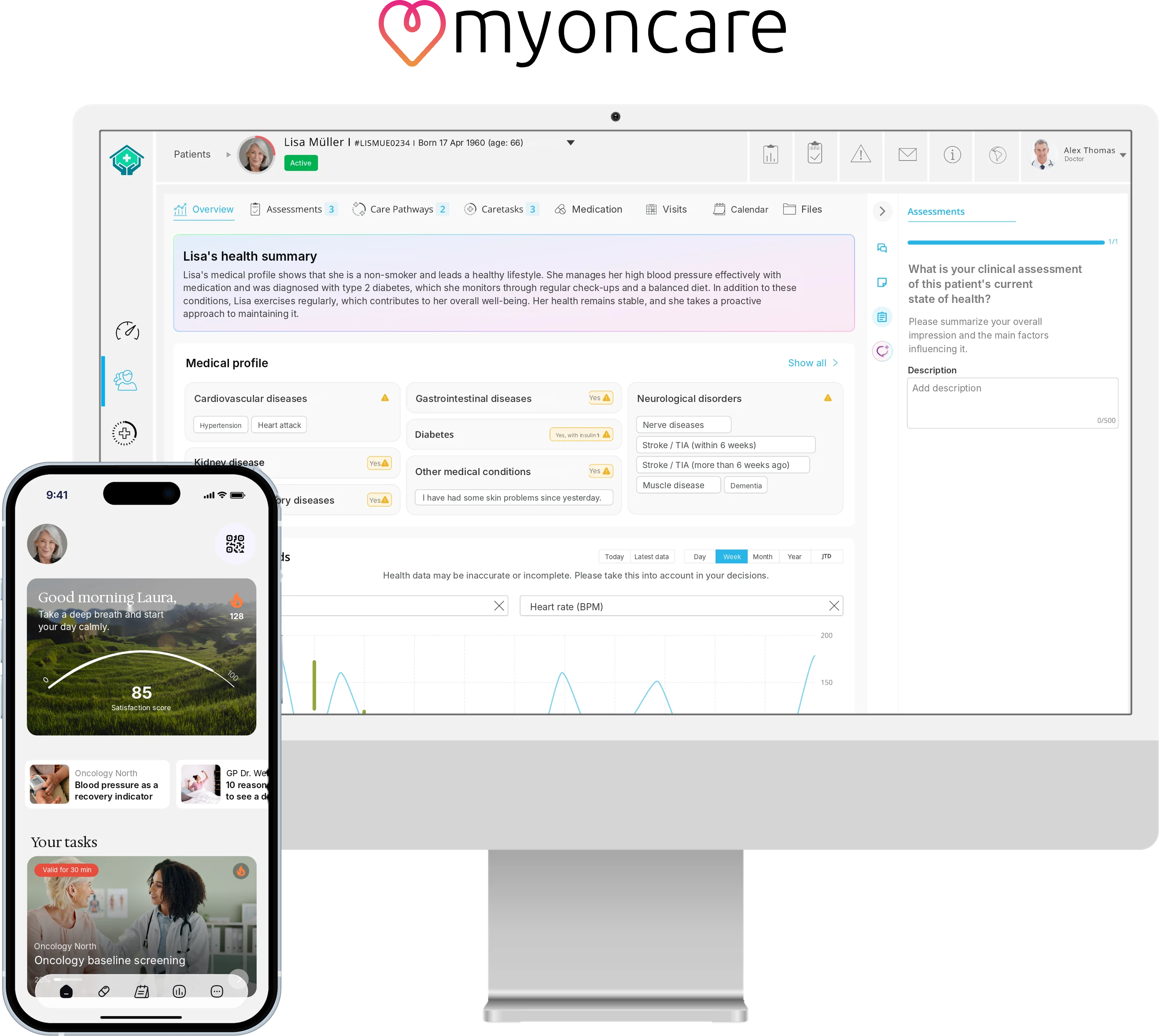
myon.clinic on desktop and smartphone: screening questionnaire in the patient app and physician dashboard with flagged results
Regulatory compliance

Runs on myoncare, a medical device under MDR class IIa.

myon.clinic uses the myoncare platform. Its MDR IIa certification is the prerequisite for automated triage and decision support based on patient data. Your screening therefore runs on a tested, regulated foundation.

ISO 27001ISO 13485C5 Type 2GDPR-compliant
Two physicians discussing patient data on a laptop

Proven and in use in oncology.

myon.clinic already supports oncology patients in everyday clinical practice, including in radiotherapy at a German university hospital.

  • Digital support before, during and after radiotherapy
  • Automated monitoring with validated PROMs
  • Care pathways for 9 radiotherapy regions

Why myon.clinic

Oncology baseline screening today, a digital care ecosystem tomorrow.

The digital platform for patient-centred care: flexible, secure and quality-assured.

MDR IIa-certified

The prerequisite for automated triage and decision support based on real-time data.

Verified security

ISO 27001, ISO 13485 and C5 Type 2, as well as FDA-listed and GDPR-compliant.

Automated care pathways

Digital pathways for any indication or treatment situation, with smart triggers and alerts.

Clear lines of responsibility

We monitor and escalate. Clinical decisions always remain with the treating physician.

7 languages

German, English, Italian, French, Spanish, Portuguese and Arabic.

No integration effort

An open system for all devices, ready to go within a few working days.

Pricing

The baseline screening for your centre. From €299 per month.

Register your centre and set up the digital baseline screening within a few working days. We support you through the launch.

From
€299per month
  • Questionnaires for all four screening areas
  • Automatic evaluation and physician report
  • Automatically generated audit report
  • No integration effort
Register now
FAQ

Your questions about the baseline screening.

Since when has the baseline screening been mandatory?

For Oncology Centres, the baseline screening has applied since the 2026 requirements catalogue, i.e. for all audits from 1 January 2026. Further certification systems, such as the Visceral Oncology Centres, follow with the requirements catalogues for audits from 1 January 2027. Psycho-oncological distress screening with a target of at least 65% has been part of certification for some time.

Is screening on paper still allowed?

Yes. The DKG accepts both digital and paper-based capture, but recommends switching to IT-based capture in the long term. Digitally, transfer and manual evaluation are no longer needed, and the documentation for the audit is available automatically.

Which questionnaires are used?

Validated instruments that are also listed in the DKG guidance: NCCN Distress Thermometer, PHQ-9, GAD-7, IPOS, PROMIS-29 and NRS-2002.

How quickly can we start?

Your centre is usually ready to go within a few working days. No integration into your IT is required.

Who makes the clinical decisions?

Always the treating medical team. myon.clinic captures, evaluates and flags abnormal results. The decision on support services remains with you.

What do patients need?

A smartphone, tablet or laptop. They start via QR code or link, for example in the waiting room or before the appointment by letter or email.

Next audit

Start now, not just before the audit.

Register your centre and capture the baseline screening digitally from the very first patient. That way your rate is in place long before the audit.

From €299 / month