Two categories, one infrastructure
One regulated platform for telemedicine networks (FTB 3) and university centres for complex diseases (FTB 4). One project, eligible under both.
FTB 3 + FTB 4on one regulated platform
MDR class IIa certified network infrastructure for telemedicine networks (FTB 3) and university centres for complex diseases (FTB 4). Ready to apply and ready to run in weeks, not years.
One regulated platform for telemedicine networks (FTB 3) and university centres for complex diseases (FTB 4). One project, eligible under both.
One regulated platform for telemedicine networks (FTB 3) and university centres for complex diseases (FTB 4). One project, eligible under both.
As an MDR class IIa medical device with KIM/FHIR, myoncare meets the eligibility criteria and the upcoming requirements of the Federal Ministry of Health (BMG). Ready to run in 8–12 weeks instead of 12–18 months.
The one-off investment is eligible for federal and state funding; ongoing operation is not. It is covered by usage fees and, in future, by a selective contract or a disease management programme (DMP).
Funding rate under Section 12b of the Hospital Financing Act (KHG), as amended by the Hospital Reform Adjustment Act (KHAG): from 2026 to 2029, the federal government covers up to 70 per cent of eligible costs. The federal states provide co-funding of at least 30 per cent and may pass on no more than half of it to hospital owners. The hospital's own contribution is therefore between 0 and 15 per cent and is handled differently in each state; from 2030, at least 50 per cent falls to the state and the owner. A selective contract requires an agreement with a health insurer and is not guaranteed.
The bottleneck is not capital but projects that are ready to apply and backed by evidence.
Projects started before 1 July 2025 are excluded. For anything later, the quality of the project description decides.
Hospitals do not apply to the federal government. The federal states review and prioritise projects and submit a joint application to the Federal Office for Social Security (BAS). The state level decides.
By then, the BMG will set binding minimum requirements for telemedicine network structures. Until they are in place, the BAS will not approve any FTB 3 application, including the 78 already submitted. Those who are prepared can start immediately afterwards.
A patient who is prepared, supported and followed up leaves hospital sooner, cancels less often and is readmitted less often. The own contribution is paid once; the effect recurs every year. What a saved bed day is worth depends on whether the bed is filled again. That is why we calculate in additional cases, not in bed days.
Lower length-of-stay threshold: 3 days. The model does not fall below it. Within this range, the DRG flat rate stays the same. The effect therefore does not come from revenue for the saved day but from the additional case that moves into the freed bed. What counts is your hospital's length of stay, not the catalogue value.
Patient information, medical history and results check take place before arrival.
1.5 percentage points fewer cancellationsComplete documents, so the theatre schedule holds.
Around 11 theatre hours saved per yearPathway management and early mobilisation. Criteria-based discharge.
1.5 bed days per case, around 750 a yearMonitoring and an escalation pathway. Complications stay in outpatient care.
Wound checks days earlier on averageFixed values from comparable projects. We will quote your specific offer in a meeting.
Why the calculator is so simple. It asks for the figures you know yourself and that drive the result: case numbers, length of stay, contribution margin and utilisation. Everything else is based on robust average values, which are disclosed here. A calculation with your actual figures belongs in a meeting, not on a website.
How it is calculated. Five years with a ramp-up: in the first year, 60 per cent of the target volume goes through the pathway, in the second 90 per cent, and from the third year the full volume. Within the length-of-stay limits, the DRG flat rate stays the same, so a saved bed day generates no revenue on its own. What is valued is the additional case that moves into the freed bed. Until this case is included in your budget agreement, it is counted at only 35 per cent under Section 4(3) of the Hospital Remuneration Act (KHEntgG); the calculator assumes an agreement from the third year.
Fixed average values. Reduction in day-of-surgery cancellations 1.5 percentage points · 90 minutes of theatre time per cancelled procedure · contribution margin €16.63 per theatre minute · 50 per cent of cancelled slots remain empty, the rest are refilled · investment €400,000 · usage fees €65,000 per year · funding rate 70 per cent · VAT 19 per cent. These values are deliberately conservative and can be replaced with your actual figures in a meeting.
Deliberately not included. Avoided wound infections. The effect is real, but depends so heavily on risk profile, type of procedure and comorbidities that a flat percentage across all patients would not be sound. Also not included: preparation and documentation time saved, coding and case-severity effects, lower audit rates by the Medical Service (MD), and revenue from a selective contract or DMP. The calculator therefore comes out lower than it could.
One hospital, not the network. Funding category 3 requires a network project with at least two participants. The benefit, however, arises in each hospital individually, with its own case numbers and its own length of stay. The calculator therefore models your hospital, and the investment refers to your share of the project, not the total volume of the network.
Eligibility of ongoing costs. In principle, operating costs that can be charged through care rates are not eligible for funding. Telemedicine network structures are an exception: under section 6.3.1 of the funding guideline issued by the Federal Office for Social Security on 26 August 2026, costs for using software under service and usage contracts, such as subscription models or software as a service, can be eligible as costs of an initial start-up phase of up to three years. Beyond that, the guideline no longer assumes an initial operating phase. The calculator reflects this: usage fees for years one to three are funded, and from the fourth year you bear them in full.
Sources. Length of stay and length-of-stay limits DRG I43B: reimbursement.INFO based on InEK · revenue per theatre minute €16.63: Waeschle et al., Der Anaesthesist, 2016 · day-of-surgery cancellation rate: published cohort of 14,893 elective patients, 1.23 per cent versus 0.48 per cent with structured pre-assessment · prehabilitation and complication rate: meta-analysis, odds ratio 0.74 · funding rates: Section 12b KHG as amended by the KHAG, and KHTFV · eligible costs: funding guideline under Section 8(1) sentence 2 KHTFV of 26 August 2026, section 6.3.1.
Important. The frequently cited reduction in length of stay of 3.5 days comes from a colorectal ERAS cohort and does not transfer to joint replacement surgery. It shows the effect of a complete pathway programme, not that of myon.clinic. Until the BMG has set the nationwide minimum requirements, the BAS will not approve applications for telemedicine network structures. All results are model calculations, not commitments.
In this project, myon.clinic does not act as a patient portal but as a regulated digital process and control infrastructure for monitoring, pathway management and cross-sector escalation. Operated as a service for a hospital network.
Funding rate under Section 12b KHG as amended by the KHAG: federal government up to 70 per cent, states at least 30 per cent, of which no more than half may be passed on to hospital owners. Hospital's own contribution 0 to 15 per cent · 66% of hospitals with an annual deficit in 2024: DKI Krankenhaus-Barometer, 2025.
The legal basis
FTB 3 and FTB 4 can be combined: a network application (FTB 3) and a parallel centre application (FTB 4) on the same technical basis.
FTB 3
No. 3 · between hospitals · incl. robot-assisted telesurgery · university hospitals included
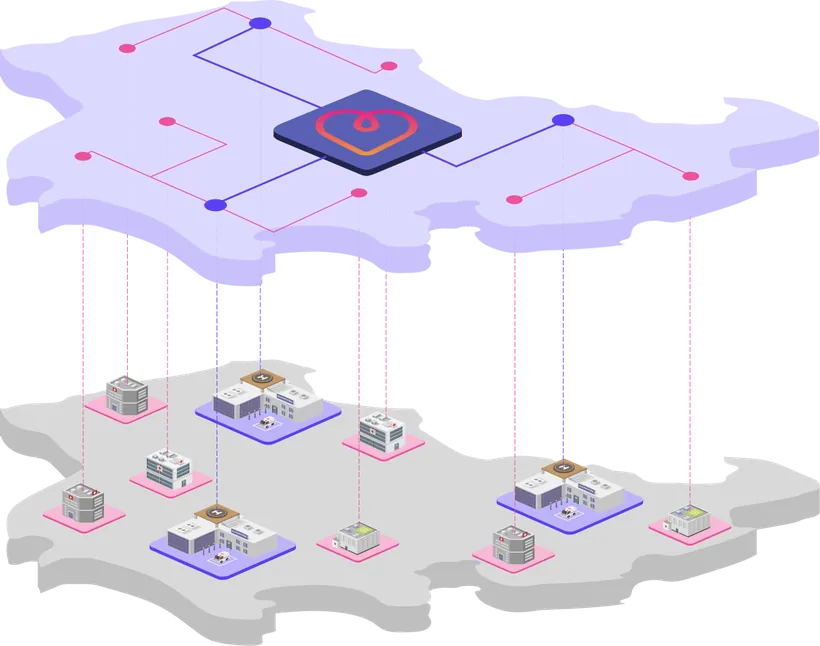
Building networks that make one hospital's particular expertise available to other hospitals: teleconsultations, monitoring, pathway management.
myoncare is the network infrastructure itself
Several hospitals as joint applicants
Meets the nationwide interoperability requirements
FTB 4
No. 4 · rare, complex or serious diseases · university hospital and non-university hospital together
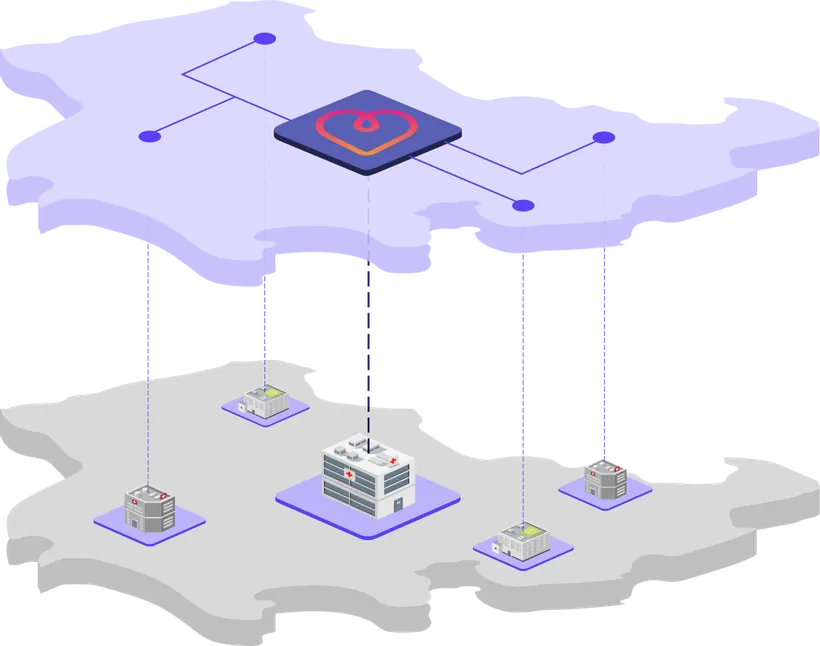
Pooling treatment expertise at a university centre. myoncare is the digital hub-&-spoke layer between the centre and the periphery.
Connects the university hospital centre and peripheral hospitals
Teleconsultation and pathway management across sector boundaries
Modular expansion per indication, without new infrastructure
Wording under Section 12b(1) sentence 4 nos. 3 & 4 KHG; specified in Section 3 of the Hospital Transformation Fund Ordinance (KHTFV).
The difference
Traditional model
HIS integration
Deep · 12–18 months
Monitoring
Hospital-specific, manual
Connecting network practices
Heterogeneous, time-consuming
Change management
High
Further indications
New project
Refinancing
Unresolved
myon.clinic
HIS integration
Efficient · 8–12 weeks
Monitoring
Central, as a service
Connecting network practices
KIM / browser, no setup
Change management
Little to none
Further indications
Module on existing infrastructure
Refinancing
Selective contract / DMP / cost savings
A content management system for medical teams and content creators, delivered to a native app or a progressive web app. Adjustable in real time, without an app update.
Easy creation of medical content and linking to pathways, now also via AI integration.
Dashboard with heatmaps and triage filtering, detail view with trends and progress curves.
When predefined thresholds are exceeded or not reached.
For direct patient communication and virtual case conferences.
The one-off investment is eligible for funding: setup, configuration, initial KIM/FHIR integration and set-up coordination. Ongoing operation (licence, hosting, MaaS) is not eligible, but is refinanced sustainably in three ways.
Care fee per patient and quarter. Requires a contract with a health insurer.
€50k to €80k per year per hospital, within normal digitalisation budgets.
Parkinson's disease and MS are DMP indications. Statutory health insurance reimbursement applies without a separate contract.
(1) Funding rate under Section 12b KHG as amended by the KHAG: federal government up to 70 per cent from 2026 to 2029, states at least 30 per cent, of which no more than half may be passed on to hospital owners. Hospital's own contribution 0 to 15 per cent, from 2030 up to 25 per cent. Awarded at full market price and in line with the Public Procurement Regulation (VgV), with no discount and no special state-aid arrangement.
We work with renowned consultancies and implementation partners to deliver projects professionally and quickly.
We map the relevant service groups, the basis of your corporate and medical strategy.
Your funding potential is assessed, and suitable projects are defined, prioritised and aligned with your state's deadlines.
We support the two-stage procedure: registration with the state ministry, transparent cost calculation, meeting all deadlines.
Seamless integration of myon.clinic into your operations, including training for your staff.
The federal states decide on funding applications. Hospital owners register projects with the responsible state ministry. For telemedicine network structures, the BAS will only approve once the BMG has set the nationwide minimum requirements.
Hospitals do not apply to the federal government. The federal states review and prioritise projects and submit a joint application to the BAS. An early, well-prepared project outline for the state gives you a head start.
Yes. As an MDR class IIa medical device with KIM and FHIR R4, myoncare is the network infrastructure itself (FTB 3) and the digital hub-&-spoke layer between the centre and the periphery (FTB 4). Legally anchored in Section 12b(1) sentence 4 nos. 3 & 4 KHG.
The one-off investment is eligible: setup, configuration, initial KIM/FHIR integration and internal project costs, at 85 to 100 per cent through federal and state funding. Ongoing operating costs are explicitly not eligible. Operation is covered by hospital usage fees and, in future, by a selective contract (Section 140a SGB V) or DMP integration (Section 137f SGB V). Both require an agreement with the payers.
In 8–12 weeks instead of 12–18 months. Operated as a service, with minimal HIS integration and network practices connected via KIM or browser, without a time-consuming on-site setup.
The contract is awarded at full market price and in line with the VgV, with no discount and no special state-aid arrangement. This keeps the project compliant with procurement and state-aid law.