Stay healthy
- Recommendations for preventive measures
- Prevention tips and plain-language information
18 digital screenings over 12 months, for mental and physical health. Employees screen themselves, the occupational physician sees findings that need attention, and your company sees only anonymised figures.
Sickness absence in Germany is high. Mental health conditions in particular lead to long absences. At the same time, most employees feel little attachment to their employer.

Every participant starts with a personal risk profile. The app then guides them through twelve health topics, each with a risk check, ongoing support, and results with a report.
1risk profile to start18health topics7lifestyle factors alongside
Alongside the twelve stages, seven lifestyle topics run all year. Your employees choose matching 7-day programmes themselves and start them directly in the app: free for them and no extra work for HR.
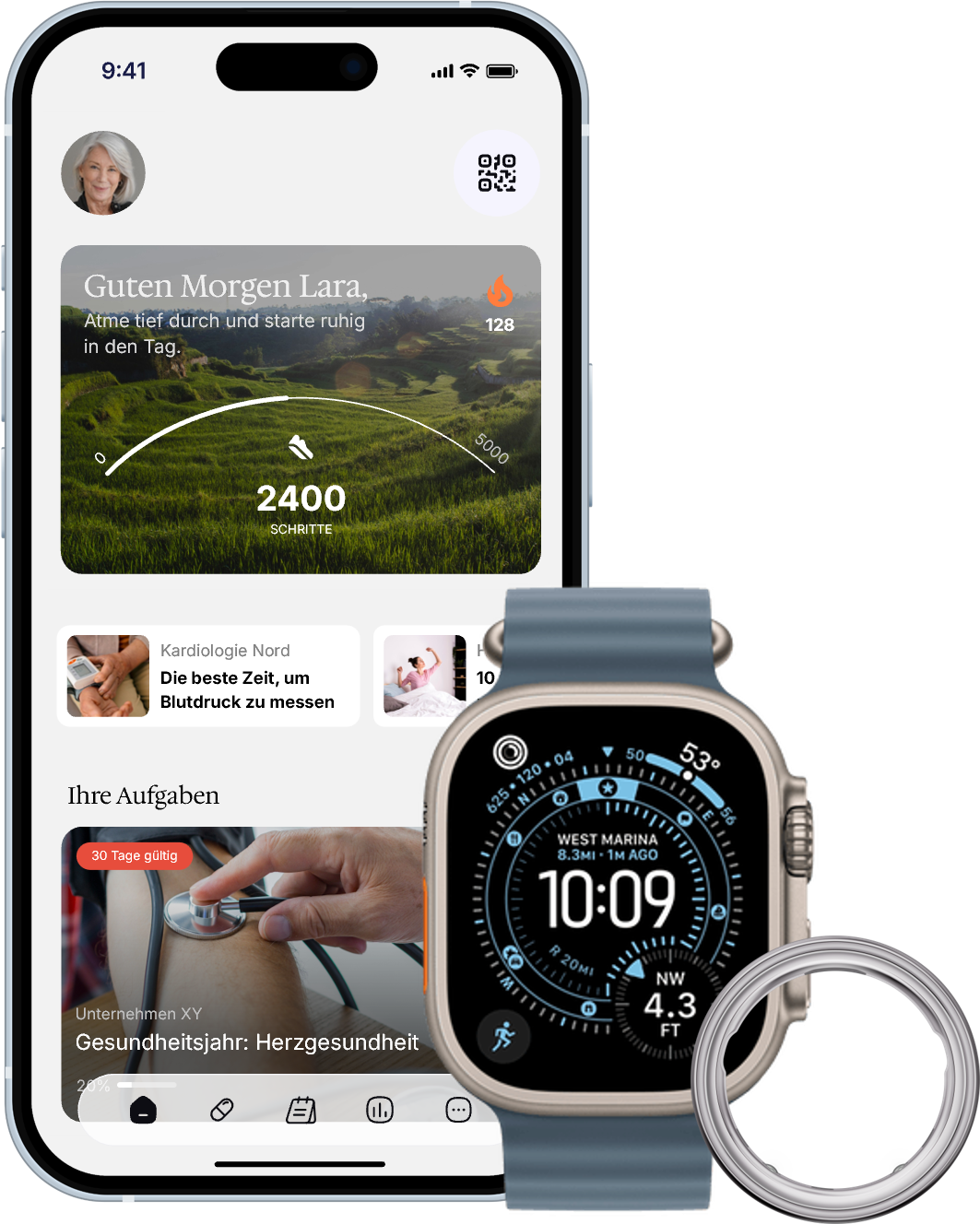
Your employees use the Health Year in the myoncare app for iOS and Android or directly in the browser. Content, questionnaires and reminders arrive exactly when they are relevant.
Employees screen themselves, the occupational physician sees findings that need attention, and your company sees only anonymous figures. All data is aggregated and anonymised.
screen themselves and see their own results.
sees findings that need attention and invites people to targeted check-ups. Only clinically relevant cases are escalated.
receives an annual report with aggregated figures and recommendations.
Reports cover groups of 10 or more people only. Individual results are never visible to the company.
are visible only to the employee and the occupational physician. Medical confidentiality applies.
sees only anonymised, aggregated reports, never individual data. Reports require a minimum group size of 10 people.
Participation is voluntary and requires each employee's consent.
 For employees
 For companies
DGUV Regulation 2 (the German statutory accident insurance rule on occupational health and safety support) requires companies to determine their individual, company-specific support needs in addition to basic support. This is exactly where the Health Year comes in.
of support time per employee and year, depending on the support group
digital screenings over 12 months. Mental and physical health, workplace and behavioural prevention.
Up to one third of support services may be delivered digitally, provided data protection and technical requirements are met.
Occupational physicians report in writing every year, including on consultations and planned measures for the following year. The Health Year report provides material for this directly.
Studies show measurable effects of workplace prevention. The evidence is strongest for programmes on stress and mental health.
On average, workplace health promotion reduces sick leave by a quarter. Every euro invested saves €2.70 through lower absence.
A 2026 meta-analysis finds a significant return on investment for programmes on stress and mental health.
Working while ill caused twice the cost of sickness absence. This effect is not included in the calculator.
Important context: the effect depends heavily on the target group, content and participation. Recent reviews find no consistent effect of health programmes overall on sick days7, and digital programmes are abandoned more often than in-person ones18. That is why the Health Year relies on personal relevance, monthly prompts and clear next steps.
Five inputs give you a first estimate. The model is deliberately conservative: it only counts avoided sick leave, with a ramp-up phase in year one.
in avoided absence costs at full effect, for 150 participants. About €32,300 in year one.
Tax: At €60 per person, the Health Year falls within the €600 tax-free allowance under Section 3 No. 34 of the German Income Tax Act (EStG), provided the requirements are met. Your employees then pay no income tax or social security contributions on it.
Illustrative model, not a guarantee and not tax advice.
| Input | Assumption | Basis |
|---|---|---|
| Sick days | Default 20.8 calendar days per employee | BAuA, cost of incapacity for work 20242 |
| Cost per sick day | Gross salary × 1.21 ÷ 365 | Employer social security contributions 2026 approx. 21%16; calendar days as in the BAuA method |
| Effect for participants | Conservative −10%, realistic −15%, optimistic −20% of sick days | Below the iga average of −25%6. Discounted because a 2026 meta-analysis finds no consistent effect7 and digital programmes are abandoned more often18 |
| Ramp-up | On average, half the effect in year one | Topics are added month by month; own assumption |
| Self-selection | Participants have 20% fewer sick days than average | Healthier employees are more likely to take part; own assumption |
| Cost | €5 per participant per month; billed only for participants | Indicative myon.clinic price; quote on request |
| Participation | Default 30% | Often below 20% for conventional programmes17; digital outreach via QR code reaches more employees |
Formula: Avoided days = participants × sick days × 0.8 × effect × ramp-up factor. Return per euro = avoided days × cost per day ÷ Health Year cost. Break-even = cost per participant ÷ cost per day.
Deliberately not included: presenteeism (studies put it at twice the cost of absence8), staff turnover, replacement costs for long-term absence, and any tax advantage. The tax exemption under Section 3 No. 34 EStG9 prevents tax and contributions on the benefit in kind, but does not reduce the company's costs, because it does not replace salary. Income taxes reduce costs and savings equally, so the benefit-to-cost ratio stays the same after tax. From the seventh week of illness, the statutory health insurer pays sickness benefit; the lost working time still remains a cost for the company.
Under Section 3 No. 34 EStG, employers can provide health services worth up to €600 per employee per calendar year tax-free. This also makes them exempt from social security contributions1020.
The Health Year becomes part of the occupational health check-up package. The price per employee rises slightly, but there is no separate contract and no separate approval.
Requirements for Section 3 No. 34 EStG: the service meets the criteria of Sections 20 and 20b of the German Social Code, Book V (SGB V) and is provided in addition to the salary already owed. Not tax advice.
Workplace health promotion receives tax relief in Germany and helps companies meet their legal occupational safety duties.
In addition to basic support, company-specific support needs must be determined. The occupational physician reports in writing every year.
Costs of workplace health measures reduce taxable profit as business expenses.
In 2024, German statutory health insurers invested €282 million in workplace health promotion and reached more than 28,000 companies.
Employers must include psychological stress at work in their risk assessment.
Mandatory once someone has been unable to work for more than six weeks within a year. Prevention lowers the risk of long absences.
Health data is specially protected, and the works council has a say on health protection and technical systems. That is why the employer receives only anonymised reports.
This overview is not tax or legal advice. Whether a specific service qualifies under Section 3 No. 34 EStG depends on certification and design, among other things. We are happy to review the requirements with you.
When a check detects a finding, myon.clinic guides the employee into the right care pathway. Example: cardio-renal-metabolic syndrome (CKM).
What your company sees: nothing personal. Findings stay between the employee, the occupational physician and the care team. You only receive anonymised figures for groups of 10 or more.
The same principle applies to other pathways, for example in Oncology. More on the CKM pathway: Metabolic syndrome.
Illustrative example. Every clinical decision remains with a physician; moving into a pathway requires consent.
We discuss your workforce, locations, funding route and how to involve the occupational physician.
By email, intranet, noticeboard or QR code. We provide the communication materials.
Employees screen themselves. The occupational physician sees findings that need attention and invites people to targeted check-ups.
Aggregated figures and recommendations for the following year, ready to use for the annual report under DGUV Reg. 2.
No. Individual results are visible only to the employee and the occupational physician, and medical confidentiality applies. The company receives only aggregated, anonymised reports, and only for groups of 10 or more people.
Yes. Participation is voluntary and requires each employee's consent.
The duties under DGUV Regulation 2 stay with the occupational physician. The Health Year complements company-specific support: the occupational physician sees findings, invites people to targeted check-ups and receives material for the annual report.
The employee receives a clear recommendation, and the occupational physician sees the alert. If a medical assessment confirms a finding, she can move into a care pathway with her consent, for example for cardio-renal-metabolic syndrome. Your company is not told about it.
For health protection measures and technical systems, the works council has co-determination rights under Section 87 of the German Works Constitution Act (BetrVG). We support you with documentation on data protection and data flows.
No. Employees register with a QR code or link and use the app or the browser. myon.clinic handles operation and data maintenance.
Yes. The Health Year runs on personal smartphones and in the browser. Invitations can also go out on noticeboards or flyers with a QR code.
As a guide, around €60 per employee per year. It can be funded through the tax-free health promotion allowance or included in the occupational health flat rate. We prepare a specific quote in the initial call.
Up to €600 per person per year is tax-free if the service is provided in addition to salary and meets the quality criteria of Sections 20 and 20b SGB V. We review the requirements for your set-up with you.
myon.clinic runs on the myoncare platform, a Class IIa medical device under the MDR, developed by ONCARE GmbH in Munich.
The standards and certifications listed refer to the quality management system (QMS) and information security management system (ISMS) of ONCARE GmbH, which is responsible for developing the myoncare health platform. More on quality & data security